| WIRELESS FLEXIBLE PERSONALIZED COMMUNICATIONS | COST 259 |
| Annual Report - Year 2 |
 |
| WIRELESS FLEXIBLE PERSONALIZED COMMUNICATIONS | COST 259 |
| Annual Report - Year 2 |
|
Period: from Apr. 98 to Apr. 99
1. Overview: Action Identification Data
| TCT Recommendation | 06 Mar. 1996 | First MC meeting | 03 Apr. 1997 |
| CSO Approval | 17 Oct. 1996 | Last MC meeting | |
| Start date: | 10 Dec. 1996 | Final Report | |
| Duration: | 36 months | Evaluation Report | |
| Extension: | TCT Evaluation | ||
| End date: | 09 Dec. 1999 |
| Austria |
10 Dec. 1996
|
Belgium |
04 Dec. 1996
|
Croatie | |
| Czech Rep. | Denmark |
27 Nov. 1996
|
Estonia | ||
| Finland |
09 Jan. 1997
|
France |
10 Dec. 1996
|
Germany |
10 Apr. 1997
|
| Greece |
29 Nov. 1996
|
Hungary | Iceland | ||
| Ireland |
30 Jan. 1997
|
Italy |
03 Feb. 1997
|
Luxembourg | |
| Malta | Netherlands |
06 Feb. 1997
|
Norway |
28 Feb. 1997
|
|
| Poland |
12 June 1997
|
Portugal |
22 Jan. 1997
|
Romania | |
| Slovakia | Slovenia |
28 May 1997
|
Spain |
10 Apr. 1997
|
|
| Sweden |
10 Apr. 1997
|
Switzerland |
06 May 1997
|
Turkey | |
| UK |
27 Nov. 1996
|
ESA |
Institutes of non-COST countries:
Area: Telecommunications
Web site: http://www.lx.it.pt/cost259
Chairperson: Prof. Luis M. Correia
Full Address:
Instituto Superior Tecnico
IT/DEEC - Torre Norte
Av. Rovisco Pais
P - 1049-001 Lisboa
Portugal
Telephone: +351-1-8418478
Fax: +351-1-8418472
Email: luis.correia@lx.it.pt
Commission Advisor: B. Arroyo
TCT Evaluator: K. Fazekas
External Evaluator:
External Evaluator:
2. OBJECTIVES
The main objective of the Action is to increase the knowledge of radio
system aspects for flexible personalised communications, capable of delivering
different services, exploiting different bandwidths, and to develop new
modelling techniques and related planning tools, in order to guarantee
the continuity (and quality) of services, delivered by networks of widely
different capabilities and structures, across a number of different environments.
Furthermore, in the perspective of a fast evolving demand for interfacing
the photonic (glass fibre) network with the wireless network, investigations
on the mutual interactions could be carried out, as well. In fact,
in the medium/long term scenario envisaged for Telecommunications by the
European Commission, the time period 2000 - 2005 would be characterised
by the emergence of PCS, with a full integration of user mobility, the
Integrated Broadband Communications (IBC) network and the Intelligent Network(s),
followed by the Photonic Network implementation at all levels (regional,
national and international). In such an environment, this Action
intends to play, in connection with the progressive deployment of the Universal
Mobile Telecommunications System (UMTS) and the Mobile Broadband System
(MBS), the role performed in the past by: COST Action 207, in connection
with the development of GSM; COST Action 231, in connection with the deployment
of GSM1800 and the development of UMTS.
The activities are having a significant impact in terms of basic Research
& Development and degree of innovation for the Signatories and the
whole mobile communications community, with particular reference to the
specification bodies. In addition, the typical benefits of a multi-disciplinary
work are being experienced, involving a number of expected participating
countries and institutions (including Central and Eastern Europe), at least
equal to those active in COST Action 231. As a secondary but not
negligible effect, the support to standardisation bodies from a large community
of researchers is providing further stimulation of the personal communication
market growth, taking into account the impact of technologies on the life
of citizens of the member states, as well as their needs and the economical
effects of such technologies.
3. TECHNICAL DESCRIPTION AND IMPLEMENTATION
The above objectives are being reached by co-ordinating the Signatories
research in several areas, which cover the following:
(i) Radio System aspects, including study on advanced access schemes,
bandwidth on demand, equalisation, interference limitation.
(ii) Network aspects, in terms of investigations on spectrum
efficiency, identification of channel allocation strategies, study of efficient
protocols for high data rates and distributed networks.
(iii) Propagation studies and simulations, using novel promising approaches
and the development of models for a sound characterisation of the short
range communications radio channel (micro- and pico-cellular environments),
together with concurrent validation measurements campaigns.
(iv) Research on intelligent/adaptive antennas, with particular attention
on the possible diversity countermeasures they are able to offer and their
influence on network planning activities.
(v) Advanced planning tools for a variety of environments, including
strategies for optimised frequency assignments.
Work is being be carried out grouped into the 3 initially foreseen
Working Groups, as follows:
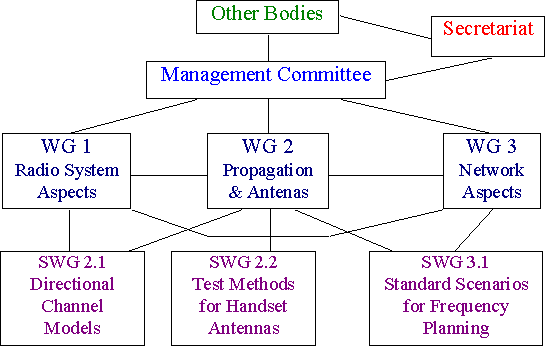
Liaisons with other bodies were established, not only with other COST
Actions in the area of Telecommunications, but also with projects in the
European ACTS and SMT frameworks, as well as with ETSI, ITU and URSI.
The Secretariat of the Action is being done externally, at Instituto
Superior Tecnico, Lisbon , Portugal, the functions of Secretary being cumulated
by the Chairman.
4. PARTICIPATION AND COORDINATION
4.1 Management Committee
Chairman: Prof. Luis M. Correia
Instituto Superior Tecnico - Tech. Univ. Lisbon
IT/DEEC - Torre Norte
Av. Rovisco Pais
P - 1049-001 Lisboa
Portugal
Tel.: +351-1-8418478
Fax: +351-1-8418472
Email: luis.correia@lx.it.pt
Vice-Chairman: Dr. Jean-Frederic Wagen
Swisscom
CIT-CT-ATS
CH - 3000 Bern 29
Switzerland
Tel.: +41-31-3423207
Fax: +41-31-3420744
Email: jean-frederic.wagen@swisscon.com
Secretary: Prof. Luis M. Correia
Instituto Superior Tecnico - Tech. Univ. Lisbon
IT/DEEC - Torre Norte
Av. Rovisco Pais
P - 1049-001 Lisboa
Portugal
Tel.: +351-1-8418478
Fax: +351-1-8418472
Email: luis.correia@lx.it.pt
WGs and SWGs Chairmen:
4.2 Participating Institutions
Participating institutions are more than 80, as follows:
4.3 Meetings of the Management Committee
The meetings of the MC during the period of this report were:
4.4 Meetings of the Working Groups
The meetings of the WGs and SWGs took place within the MC meetings
mentioned above, except for SWG 2.1, which had an extra meeting in 24-26
Mar. 1999.
5. RESULTS
Although some tasks were due to be finished by the end of Year 2, work
has continued to be presented in all of them, and a decision was taken
to keep them open until the end of the Action. Thus, still, no final
model or algorithm has been achieved. However, some results have been obtained
in some of the areas addressed in the Action, as for example: OFDM transmission
techniques, enhancement of TDMA systems, and near-far resistant techniques
in CDMA, within WG 1; propagation characteristics for broadband radio access
at mm waves, test scenarios for systems with adaptive antennas, characterisation
of directional radio channels, and evaluation of adaptive antennas for
GSM and wideband CDMA, within WG 2; traffic modelling and its influence
in planning optimisation, planning algorithms for interference reduction
in cellular networks, comparison of frequency assignment algorithms, and
spectral compatibility of DECT and UMTS services, within WG 3.
A new SWG was set up at the MC meeting in Jan. 1999, on “Test Methods
for Handset Antennas”, with the goal to establish reference methods that
can be used by everyone to characterise antennas on mobile phones.
A total of 114 technical documents were presented to the MC in 1998,
while during the first two meetings of 1999 a total of 69 documents have
already been presented. These numbers, together with the fact that
meetings are usually attended by 80 to 100 people, show that the Action
is very much alive, and the work being done within it is of interest to
many people and institutions, besides the official members of the MC.
Continuing the COST 231 policy of having the yearly Workshop in conjunction
with other Actions that have common areas of interest, COST 259 organised
its 1st Workshop together with COST 252 (Apr. 1998, Bradford, UK), and
the 2nd with COST 260 (Apr. 1999, Vienna, Austria). Both were a success,
the latter having been attended by more than 150 people; this number of
attendees shows that there is great interest in the work being done in
the Action (together with the companion ones).
It is the belief of the MC that the work being carried out within the
Action is of top quality at the international level, which can be measured
by the following. According to a suggestion of the MC to the Chairman of
the IEEE Vehicular Technology Conference 99 - Fall, papers from the Action
were submitted to the conference, and were evaluated by the usual rules
of refereeing. From a total of 20 papers, 19 were accepted for presentation
(i.e., only 5% rejection), and 2 specific sessions devoted to COST 259
Indoor and Outdoor Propagation will be set up in the conference.
In preparation of the Final Report, which is desired to be structured
as a book, as it was the case of the previous COST 207 and COST 231, a
preliminary Table of Contents was already established at the last meeting
in Vienna, and chapter and section editors have already been appointed.
6. DISSEMINATION OF RESULTS
6.1 Publications and Reports
During 1998, 114 technical documents were presented to the MC, while
in 1999 that number is of 69 (up to now). The complete list of documents
(title, authors and its affiliation, and abstract) is available at the
Action web site, and can be sent upon request.
6.2 Conferences and Workshops
Two Workshops were organised:
6.3 Web site
The Action web site address is: http://www.lx.it.pt/cost259.
From a front page, one can have access to several pages, described
below with the respective contents:
6.4 Scientific and Technical Cooperation
There are formal liaisons with other projects within European frameworks,
COST 252, COST 255, COST 260, ACTS/MEDIAN, ACTS/SUNBEAM, ACTS/FRAMES and
SMT/METAMORP, besides other less regular contacts.
6.5 Transfer of results
There are formal liaisons with standardisation bodies, not only at
the European level, i.e., ETSI/BRAN, ITU/SG3, URSI/C, besides other less
regular contacts.
The main European operators in the area of mobile/wireless communications
are present in the Action: Mobilkom Austria, Telecom Denmark Mobile France
Telecom / CNET, CEGETEL / SFR, TDF-C2R, Deutsche Telekom, E-plus Mobilfunk,
Mannesmann Mobilfunk, CSELT, Italtel, OMNITEL, KPN, Telenor R&D, PTK
Centertel, Telecel, Telefonica I & D, Telia Research, Swisscom, Vodafone.
Also main European manufacturers in the area of mobile/wireless communications
are present: Nokia, Alcatel, Siemens, Allgon, Ericsson, Motorola.
7. ECONOMIC DIMENSION
The estimated effort for the entire Action is 50 person/year.
The funds granted by the Commission since the beginning of the Action
are as follows: 1997 - 50 kEuro; 1998 - 115 kEuro, to which an amount of
11.5 kEuro was added specifically for Short-Term Missions; 1999 - 114 kEuro.
8. SELF EVALUATION
COST 259 is devoted to an area of huge expansion in Telecommunications,
the wireless/mobile one, which allows very close contacts between universities
and research labs on one hand and operators and manufacturers on the other,
thus enabling conditions for a successful cooperation and very fruitful
development of research. However, it also imposes an increased responsibility
to the participants, due to the expectations that are created to the results
of the Action, as it happened with the previous ones, COST 207 and COST
231. The work being carried out up to now constitutes a guarantee
that the same level of quality in the final results will be maintained:
the large attendance of both the workshops (over 120) and the MC meetings
(over 80), the number of technical documents being discussed at each MC
meeting (around 40), and the recognition by international referees of the
quality of the work (only 1 out of 20 papers coming specifically from COST
259 was rejected for presentation at IEEE VTC’99-Fall), among other things.
Besides this, the work on the Final Report has already started, a draft
of the Table of Contents has been established, and editors have been appointed
for the various chapters and sections.
As a consequence of what was stated above, the Action is not facing
serious difficulties. The fact that a large group of people participates
poses some additional management problems, as well as increased difficulties
in organising the meetings, not only from the logistic point of view (in
finding rooms for the plenary and for the parallel sessions of the WGs
and SWGs meetings) but from financial one as well (since the Commission
is not funding the meetings organisation, external sponsoring has to be
found, and although the sponsoring for the MC meetings has always been
successful, it is not as easy as for a small group of people). Nevertheless,
all these problems have been dealt with in a satisfactory manner.
However, the Action is facing a problem since it started, for reasons
that go beyond anyone’s fault. The former Chairman of the Action,
Mr. Eraldo Damosso (CSELT, Italy), was ill for quite some time, during
the early days of the kick-off of the Action, which caused a huge delay
in the real start of the work: although the official date of start is 10
Dec. 1996, the first meeting of the MC was held only on 3 Apr. 1997, i.e.,
with a 4 month delay (on a 36 month project), which is too much.
As a consequence there is in fact a delay of the work from the initial
timetable, and it will be very difficult to finish the work until the 9
Dec. 1999, as initial planned, in order to maintain the same quality of
the final report as the previous projects. Hence, a “Technical Extension”
of 4 month (exactly the delay of the start of the work), i.e., up to Apr.
2000, is being requested to the TCT, so that the calendar of 36 month of
work is really fulfilled. Provisional dates for meetings in Jan.
2000 and Apr. 2000 are already set up, and organisations have already volunteered
for hosting the meetings, which, once more, shows the real commitment of
the group to achieve the goals that were established at the beginning of
the project.